
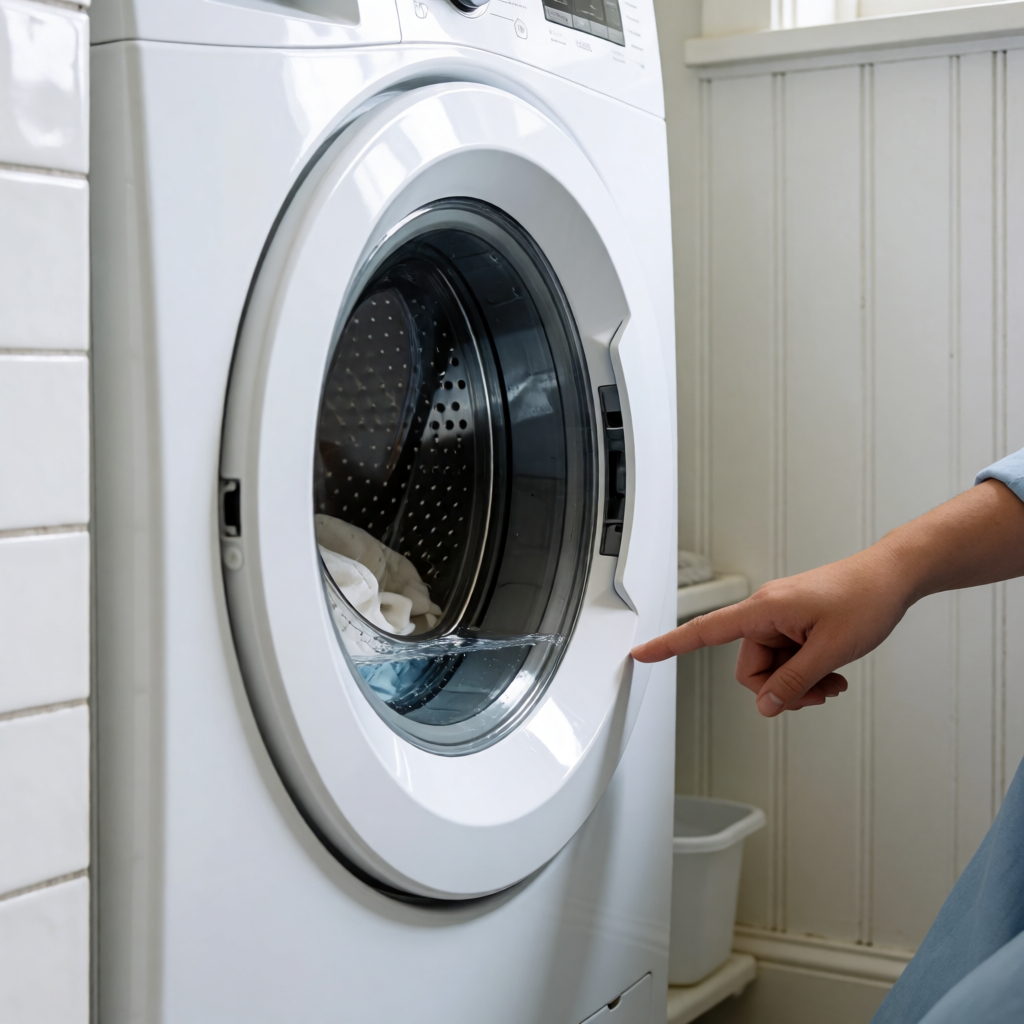
You open your washing machine after a cycle and find that there is still water sitting inside.
If you’re wondering why your washing machine is not draining, don’t panic. A washer that won’t drain can sometimes have a simple problem that you can identify and fix yourself.
A blocked drain hose, clogged filter, unbalanced load, incorrect cycle setting, or too much detergent can all cause drainage problems.
Before assuming that the drain pump has failed, work through these simple checks.
Why Is My Washing Machine Not Draining?
A washing machine needs to pump dirty water out of the drum before the spin cycle can finish.
If the water remains inside the washer, something may be preventing the water from leaving.
The most common causes include:
- A kinked or blocked drain hose
- A clogged pump filter
- A blocked household drain
- An unbalanced or overloaded load
- An incorrect cycle or spin setting
- Too much detergent
- A problem with the drain pump
The exact design varies between washing machines, so always check your owner’s manual before removing a filter, hose, or other component.
1. Check the Washing Machine Cycle
Before taking anything apart, check the cycle you selected.
Some gentle or delicate cycles use slower spin speeds and may leave more water in the clothes than a normal cycle.
If your washing machine has a Drain & Spin or Spin option, try running it after checking that the load is properly balanced.
If the washer drains normally during this cycle, the problem may have been related to the selected wash cycle rather than a mechanical failure.
2. Check for an Unbalanced or Overloaded Load
A washing machine may reduce or stop the spin cycle when the load becomes badly unbalanced.
This can happen when you wash a large heavy item, such as a blanket or bath mat, by itself.
Open the washer and redistribute the clothes evenly.
If the drum is packed tightly, remove some items and try the Drain & Spin cycle again.
A load that cannot spin properly can leave clothes much wetter than normal and may make it appear that the washing machine is not draining correctly.
3. Inspect the Drain Hose
The drain hose is one of the first things you should check when a washing machine won’t drain.
Look behind the washer and inspect the hose for:
- Kinks
- Crushing
- Sharp bends
- Visible blockage
- Incorrect positioning
A kinked hose can restrict the flow of water.
Carefully straighten the hose if necessary.
Also check where the hose enters the household drain or standpipe. The correct installation height and hose position vary by model, so use your owner’s manual for the exact requirements.
Don’t push the hose too far into the drain
The drain hose should not simply be pushed as far as possible into the household drain.
Depending on the washer, inserting it too deeply or installing it incorrectly can interfere with proper drainage.
Follow the installation instructions for your specific model.
4. Check the Washer’s Drain Filter
Some washing machines, particularly many front-load models, have a drain pump filter designed to catch small objects, lint and debris before they reach the pump.
A clogged filter can prevent the washer from draining properly.
The filter may be located behind a small access panel near the bottom front of the washer.
Before opening the filter
Turn the washing machine off and disconnect it from power.
If there is water inside the drum, be prepared for water to come out when the filter is opened.
Place:
- Towels on the floor
- A shallow container underneath
- Another container nearby if necessary
Some machines have a small emergency drain tube next to the filter. Others do not.
Do not assume every washing machine has an accessible filter. Filter locations and procedures vary by model.
If you cannot find the filter, check your owner’s manual rather than removing random panels.
5. Check the Household Drain
Sometimes the washing machine is not the problem.
The household drain or standpipe may be partially or completely blocked.
If possible, check whether the drain is backing up or draining slowly.
You can also watch what happens when the washing machine attempts to pump out the water.
If water backs up around the drain or laundry sink, the plumbing may be restricted.
In that situation, the washing machine may be working normally but cannot push water through a blocked household drain.
6. Check How Much Detergent You Are Using
Using too much detergent can create excessive suds.
Excessive suds can interfere with proper washing and draining, particularly when the wrong type of detergent is used.
If your washing machine requires HE (High Efficiency) detergent, use HE detergent and follow the amount recommended by the manufacturer.
More detergent does not necessarily mean cleaner clothes.
In fact, using too much can create additional problems.
7. The Drain Pump May Be Blocked or Faulty
If you’ve checked the cycle, load, drain hose, filter and household drain but your washing machine still won’t drain, the drain pump may be the problem.
The pump is responsible for moving water out of the washing machine.
A small object such as a coin, hairpin, sock or other debris can sometimes interfere with the pump.
However, accessing the pump may require removing panels or other components.
If you are not comfortable working inside the appliance, this is a good point to stop troubleshooting and consider professional help.
How to Drain a Washing Machine Full of Water
If your washer is full of water, don’t immediately try to move it.
A washing machine full of water can be extremely heavy.
Instead, first check whether your model has an emergency drain tube or accessible pump filter.
For a front-load washer, the filter or emergency drain system may be located behind a small lower access panel.
Place a shallow container and towels underneath before opening anything.
For a top-load washer, the procedure can be different, and some models do not provide easy access to the drain system.
Always check the owner’s manual for your specific model before attempting to manually drain the appliance.
What If the Washing Machine Drains Slowly?
A washer does not have to be completely full of water to have a drainage problem.
Slow draining can be an early warning sign.
Look for:
- Water taking unusually long to disappear
- Clothes remaining wetter than usual
- Water sitting in the drum after a cycle
- A drain pump making an unusual noise
- Repeated drainage errors
- Water backing up into the laundry sink
If the problem is getting progressively worse, check the drain hose and filter before the washer stops draining completely.
What Not to Do
When your washing machine won’t drain, avoid these common mistakes.
Don’t keep restarting the washer
Repeatedly running cycles with standing water can make the problem worse and may put additional strain on the pump.
Don’t open a filter without preparing for water
A significant amount of water may come out.
Always have towels and a suitable container ready.
Don’t remove electrical or internal components unnecessarily
You do not need to dismantle the washing machine to perform basic troubleshooting.
Start with the simple checks.
Don’t ignore unusual noises
Grinding, buzzing or repeated clicking from the drain area can provide useful clues about a possible pump or obstruction problem.
When Should You Call for Help?
You can safely perform basic checks such as inspecting the hose, checking the cycle and redistributing the load.
However, consider professional help if:
- The washer still won’t drain after basic troubleshooting.
- The drain pump appears to be faulty.
- You need to remove electrical or internal components.
- There is a burning smell.
- Water is leaking from inside the appliance.
- The washer repeatedly displays a drainage error.
- You cannot safely access the filter or pump.
- The household drain appears to have a serious blockage.
If you’re unsure about a repair, stop before opening electrical or internal components.
Quick Washing Machine Drain Checklist
Before calling for help, check:
☐ Is the correct cycle selected?
☐ Is the load balanced?
☐ Is the washer overloaded?
☐ Is the drain hose kinked?
☐ Is the drain hose blocked?
☐ Is the household drain clogged?
☐ Does your washer have a drain pump filter?
☐ Is the filter clogged?
☐ Are you using the correct detergent?
☐ Is the drain pump making an unusual noise?
Bottom Line
If you’re asking why your washing machine is not draining, start with the simplest possibilities.
Check the cycle, redistribute the load, inspect the drain hose and check whether your model has an accessible drain filter.
If those steps don’t solve the problem, the drain pump or household plumbing may need further investigation.
You don’t always need a new washing machine just because it won’t drain. Start with the simple checks before assuming that a major repair is necessary.
For model-specific instructions, always consult the manufacturer’s owner’s manual. Whirlpool also provides a useful troubleshooting guide covering drain hoses, pump filters, drainage and other common washer problems.